The physical language of anxiety
If you’ve ever felt your heart race before you even knew why you were anxious, you are experiencing the "physical language" of your nervous system. Understanding why your body reacts before your mind is the first step toward interrupting the survival loop and finding your steady rhythm again.
Chronic anxiety "Survival Mode"
Understanding why your body reacts before your mind
Over the years, I’ve noticed a consistent theme: anxiety rarely stays in your head. For most of my patients here in Manalapan, it starts as a physical event. It’s the sudden cold sweat, the tightening in the chest, or the "knot" in the stomach that appears before you’ve even identified a stressful thought.
If we want to treat anxiety effectively, we have to move past the "worry" and understand the biological engine driving the response.
A Relay Race In Your Brain
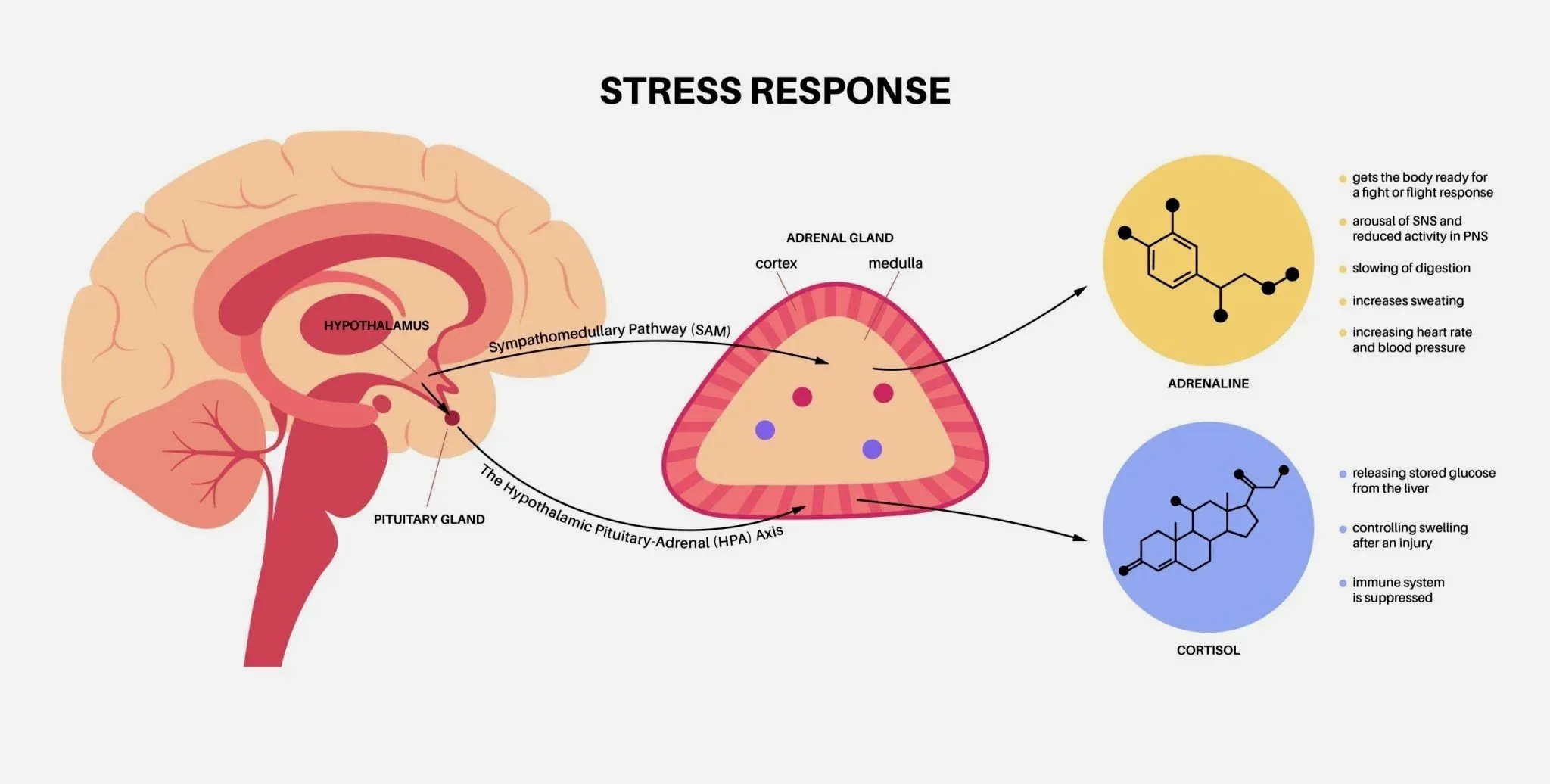
To understand why your body reacts so fast, we have to look at the Hypothalamic-Pituitary-Adrenal (HPA) axis. Think of this as your body’s central command center for stress.
When you sense danger, your brain doesn't stop to ask questions; it triggers a high-speed relay race:
The Hypothalamus (The Command Center): It spots the "threat" (like a looming deadline or a difficult conversation) and sends an emergency signal.
The Pituitary Gland (The Messenger): It receives the signal and releases hormones to alert the rest of the body.
The Adrenal Glands (The Action Team): These glands flood your system with cortisol and adrenaline, prepping you to fight or run.
In a healthy system, the race ends when the threat is gone. But in chronic anxiety, the team never stops running. You’re essentially stuck in a survival loop, which is why you feel "on edge" even when you know you’re safe.
Reading the "Physical Dialects" of Anxiety
Anxiety manifests differently for everyone. By identifying your specific "somatic" (physical) symptoms, we can better understand how your nervous system is responding.
Common physical signs include:
Cardiovascular: Rapid heart rate, palpitations, or a "fluttering" sensation in the chest.
Respiratory: Shallow breathing or the feeling that you can’t quite take a full, deep breath.
Gastric: Nausea, "butterflies," or chronic digestive issues (this happens because the Vagus Nerve connects your brain directly to your gut).
Muscular: Jaw clenching, tension headaches, or "armoring" (subconsciously raising your shoulders toward your ears).
Identifying these isn't just about labeling discomfort; it’s about recognizing that your Autonomic Nervous System is trying to protect you using an outdated survival script.
Why You Feel Everything So Intensely
"Many of my patients have 'high interoceptive awareness,' meaning they are hyper-attuned to their internal state. A tiny spike in heart rate becomes a loud alarm for an anxious person."
A tiny spike in heart rate that someone else might ignore becomes a loud alarm for an anxious person. This creates a "bottom-up" cycle: your body feels a sensation, your brain interprets it as danger, and then your brain sends more stress signals to the body. Breaking this loop requires more than "positive thinking"—it requires biological stabilization.
How Psychiatry Helps Reset the Baseline
This is where my medical background serves as a silent engine for your care. After two decades in clinical practice, I’ve found that trying to "talk your way" out of a biological response is an uphill battle.
Psychiatric medication is often the most effective tool to "lower the floor" of your physical intensity. We aren't just masking feelings; we are regulating the neurochemistry that dictates your stress response.
Stability: Medication helps quiet the "alarm" from the HPA axis.
Space: By lowering physical distress, we create the mental room you need to engage in your life again.
Resilience: We are essentially re-training your system to recognize when it is actually safe.
Your Path Forward
You aren't "weak" because you have physical symptoms. Your system is simply over-performing its survival duties.
If you’re navigating new symptoms or a recent diagnosis, these resources are here to provide the map. They are designed to help you move forward with the clarity and confidence you need to feel like yourself again.
Whether we connect in my Manalapan office or through secure telehealth, let’s start finding your steadier rhythm with a clinical evaluation.
Frequently asked questions
-
Because the stress response involves real hormones like cortisol and adrenaline. These affect your heart, lungs, and digestion instantly. A clinical evaluation can help differentiate somatic anxiety from other medical conditions.
-
Medication helps balance the chemicals in your brain that signal "danger." By smoothing out these signals, your heart rate and muscle tension can return to a normal, resting state.
-
Absolutely. The brain is remarkably adaptable. Through a combination of medication management, lifestyle adjustments, and professional support, you can learn to lower your baseline stress level and build lasting resilience.